Design Challenge 7:
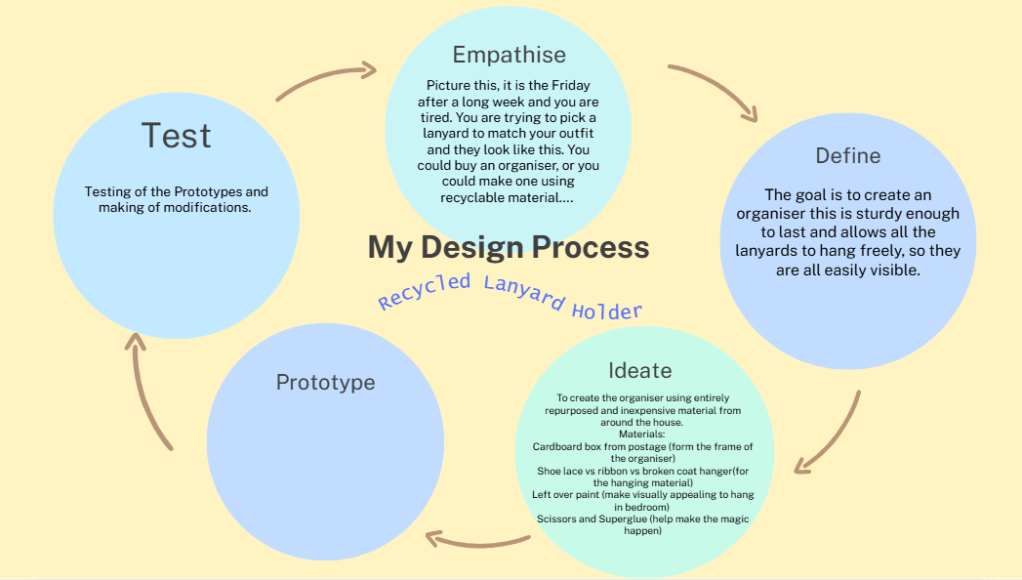
This MindMap above was created using the design thinking model created by Stanford d.school.
Curriculum Links
| Achievement Standard: | |
| By the end of Year 4 students describe how people design products, services and environments to meet the needs of people, including sustainability. For each of the 2 prescribed technologies contexts they describe the features and uses of technologies and create designed solutions. Students select design ideas against design criteria. They communicate design ideas using models and drawings including annotations and symbols. Students plan and sequence steps and use technologies and techniques to safely produce designed solutions. | |
| Content Descriptors | |
| AC9TDE4K01 | Examine design and technologies occupations and factors including sustainability that impact on the design of products, services and environments to meet community needs |
| AC9TDE4P01 | Explore needs or opportunities for designing, and test materials, components, tools, equipment and processes needed to create designed solutions |
| AC9TDE4P03 | Select and use materials, components, tools, equipment and techniques to safely make designed solutions |
| AC9TDE4P04 | Use given or co-developed design criteria including sustainability to evaluate design ideas and solutions |
| AC9TDE4P05 | Sequence steps to individually and collaboratively make designed solutions |
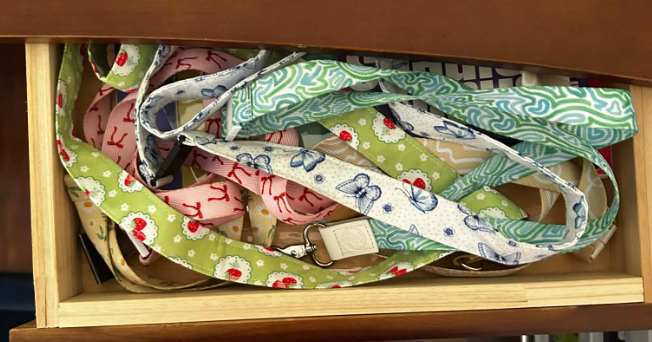
The Problem
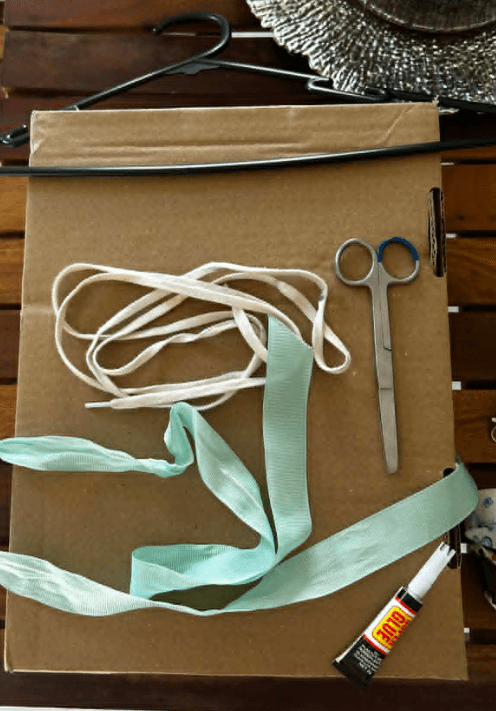
The Materials for the Solution
Prototypes and Tests
Click for photos of Prototypes
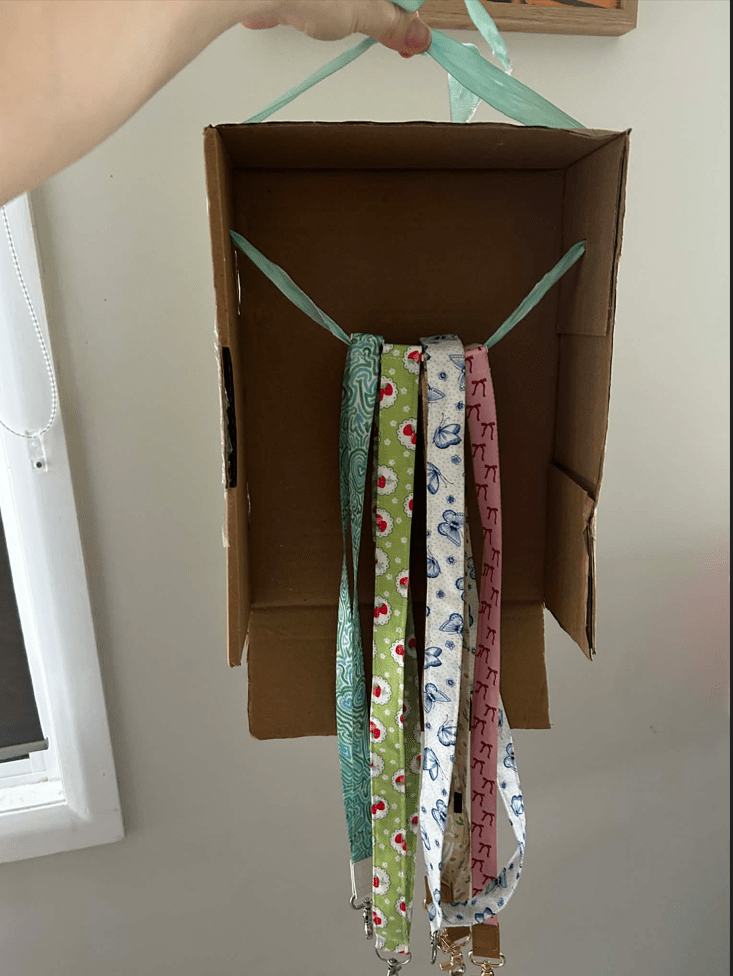
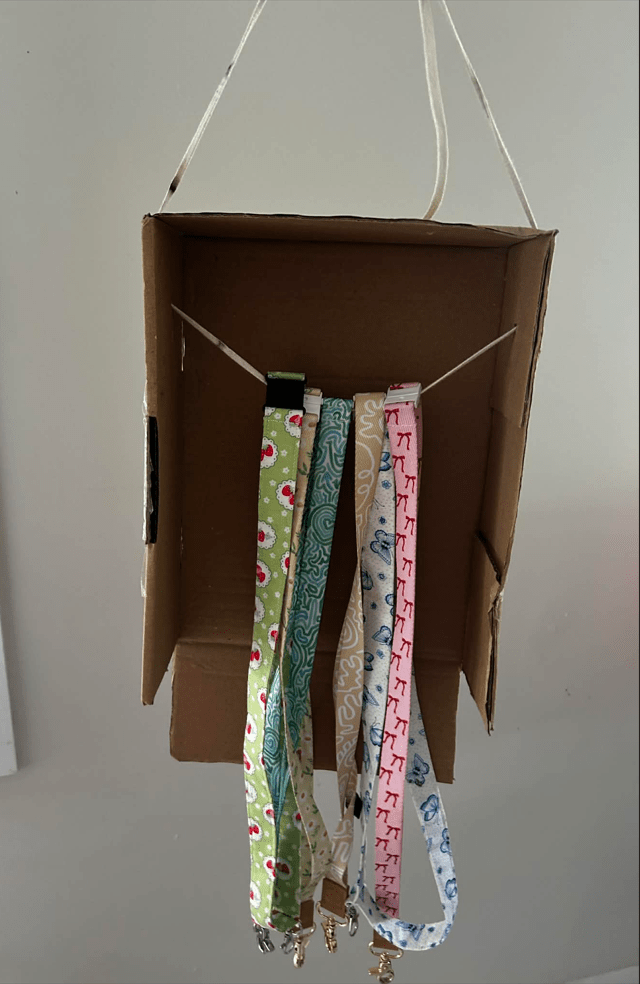
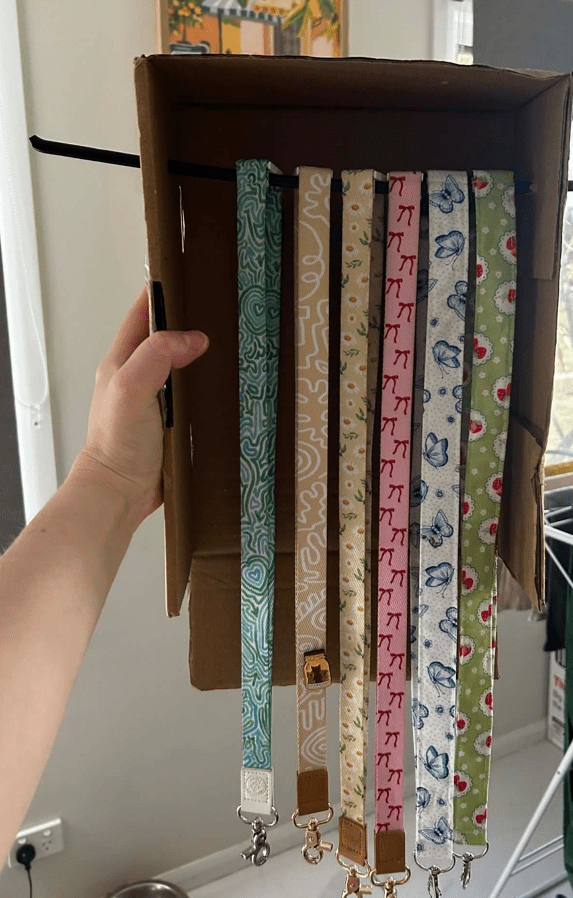
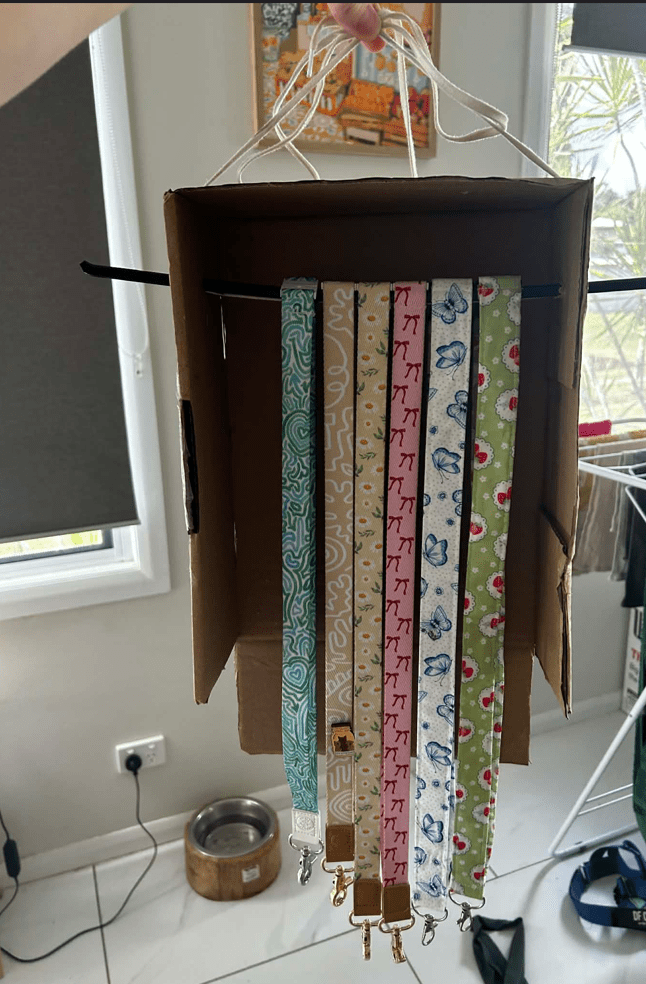
The Testing Process:
Prototype One: I wanted to test the ribbon first because it was a pretty colour and I thought if I could tie it up the top, I would have a way to attach it to my wall (via hanging hook). The ribbon wasn’t sturdy enough to support the weight of the lanyards and as a result all of them slide down and bunched at the bottom.
Prototype Two: Like the ribbon, I liked the idea of having the tie at the top to attach it to the wall. I thought potentially the shoelace would be sturdier to prevent pooling of lanyards however it wasn’t. It was easier however to thread the lace through the holes in the cardboard and create the design.
Prototype Three: This prototype utilized the repurposed (broken) coat hanger which was very effective at holding the lanyards in a neat visible manner, placing all on display. I didn’t like this model however as I wouldn’t be able to attach it to a wall/hang it.
Prototype Four: To combat the design flaw, I used both the shoelace, to create the hanging mechanism, and the repurposed coat hanger. This allows me to attach it to a wall as well as create a sturdy bar for which to hand my lanyards, so they are all visible.
The Final Product
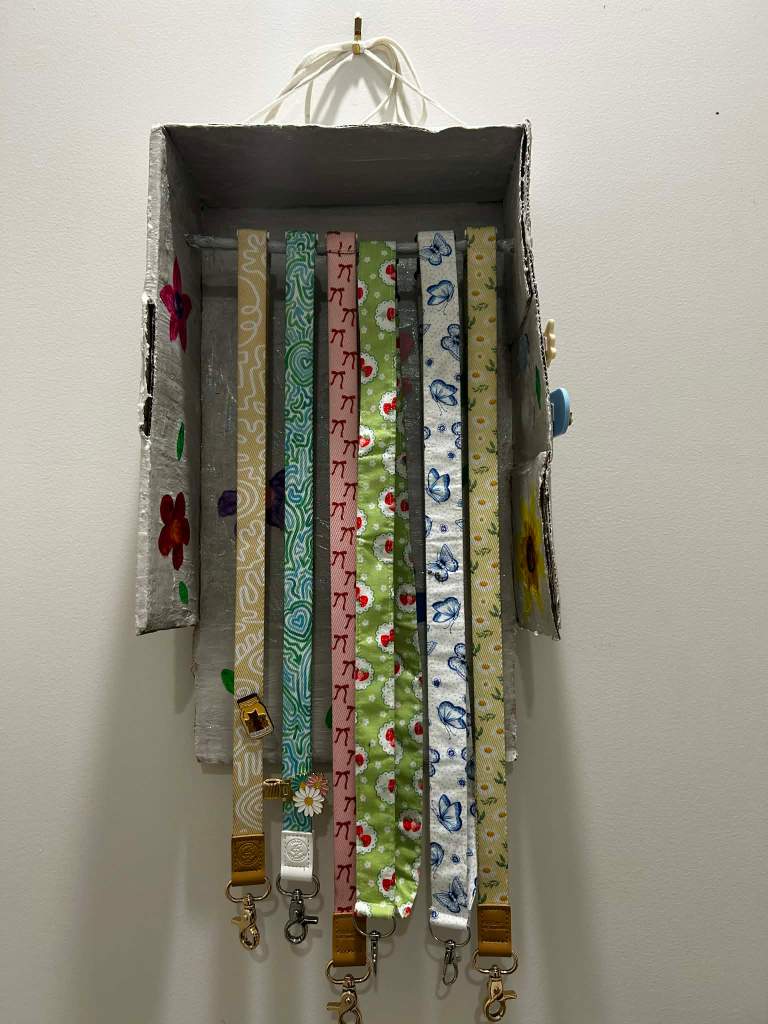
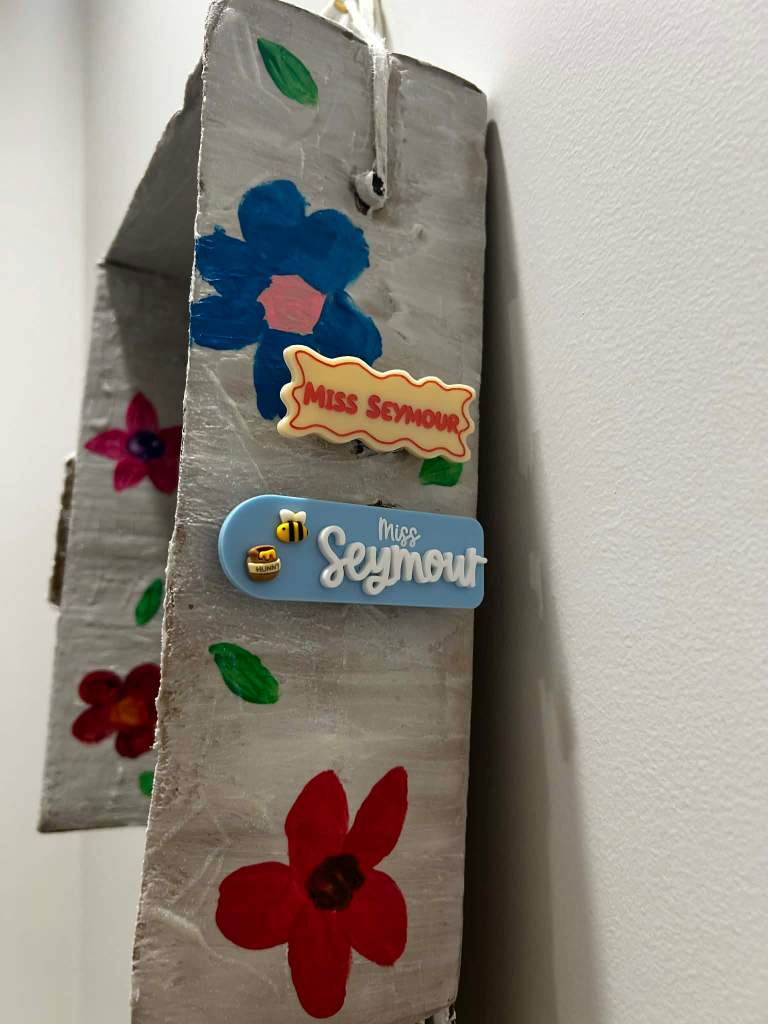
I found some old magnets and was able to incorporate them into the design so I could attach my magnetic name badges and keep everything together!
Design Challenge 8:
Risk Assessment:
Risk assessment below created based off the Curriculum Activity Risk Assessment Risk Matrix:
| Hazard | Risk | Prevention Measure | Risk Level |
| Scissors (cutting and creating holes in cardboard) | Potential for students to injury self or others if not used correctly. | Explicit modelling of technique when using scissors. Clear expectations around scissor use | Medium |
| Shoelace | Potential for student to misuse and wrap around neck of self or peer | Explicit instruction and clear expectations around use. | Low |
| Superglue | Potential for students to stick fingers together. Potential for skin irritation from super glue. Potential to get superglue on clothes. | Supervision when using super glue. | Medium |
| Coat hanger | When adjusting coat hanger shape, may snap and scratch/ injure student or plastic may fly and hit a peer/ teacher. | Teacher to assist with this step | High |
| Paint | Potential for students to ingest paint | Explicit instruction and clear expectations around use. | Low |
| Paint | Potential for students to get paint on uniform | Explicit instruction and clear expectations around use. | Low |
Reflections:
This challenge allowed me to develop my understanding of the design process, specifically the ethical and sustainability component of the curriculum. For me, the most difficult part of the of this technology challenge was thinking of an idea for a product to create. I wouldn’t consider myself a creative or innovative individual and therefore it took me a while to find something I could create. Having now completed the challenge, and taking the opportunity to reflect I realise that while creativity and innovation is helpful, it’s not essential for success. I imagine if I feel this way, it is likely my future students may too and by having an understanding of this will greatly enhance my teaching. `It surprised me how much I ended up enjoying this challenge, and how much pride I had when viewing my completed product. I felt such a sense of achievement that not only had I designed the concept but that I had created the product using sustainable and ethically sourced materials.
References:
Australian Curriculum. (2022). F-10 Curriculum | V9 Australian Curriculum. https://www.australiancurriculum.edu.au/f-10-curriculum/learning-areas/design-and-technologies/year-4?view=quick&detailed-content-descriptions=0&hide-ccp=0&hide-gc=0&load-detailed-content-descriptions=null&side-by-side=1&strands-start-index=0
Queensland Government. (n.d.). Curriculum Activity Risk Assessment (CARA) process. Education. https://education.qld.gov.au/curriculum/stages-of-schooling/CARA
Stanford d.School. (2010). A Design Thinking Process. https://web.stanford.edu/class/me113/d_thinking.html

