DESIGN INFOGRAPHICS
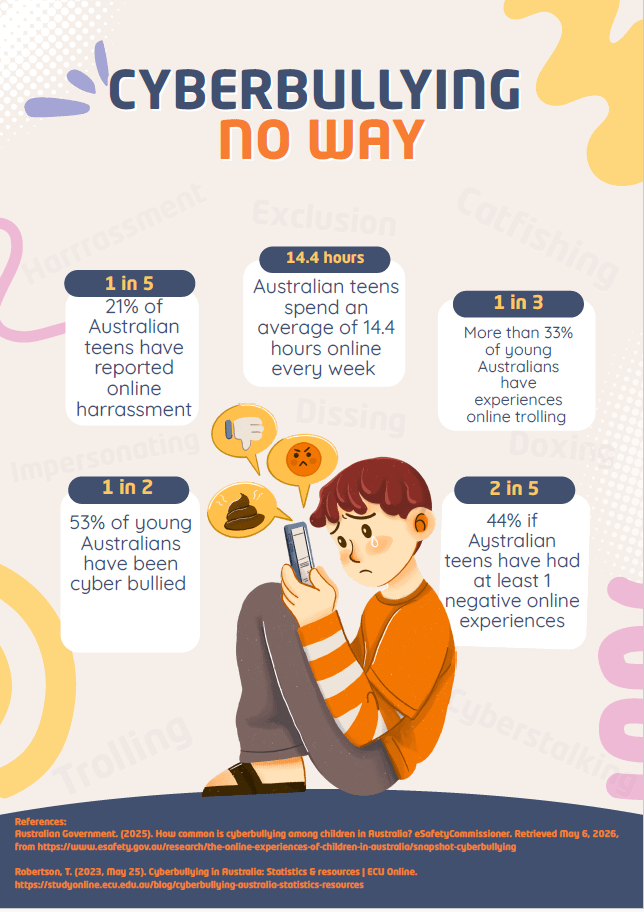
When designing this infographic, I wanted it to be able to grab the attention of young people which is why it has a large graphic of a little boy in the middle and I have utilised bright colours in the design. This is also why I included both the percentage representation and fractional representation for the statistics to assist you people in conceptually understanding the impacts of cyberbullying.
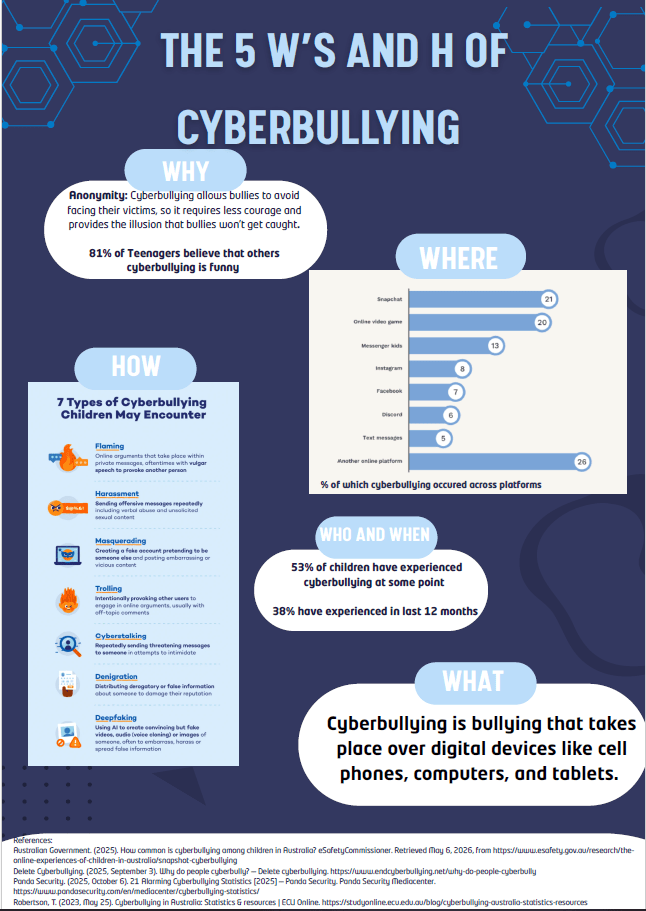
This second infographic was designed more towards older students and adult viewers. It is set in darker tones to highlight the seriousness of cyberbullying. For this infographic I created the design around the 5 Ws and H, or the reporters’ questions. My logic for this was that it removes all need for inference from the poster and instead provides viewers with all essential information.
Reflection:
As someone who enjoys creating posters and visual aids for information, I found this task to be incredibly enjoyable. The process using CANVA was incredibly easy, however I am mindful that I am someone who uses it regularly already. I think if a task like this was expected of students, many would greatly enjoy it and with appropriate scaffolding, many would be able to do so very successfully.
I found the concept of making quite a serious topic visually appealing strange and for my first poster was a bit worried that I was underplaying the seriousness of cyberbullying too much. I had to remind myself however who my target was for the information and that if it was too dark and serious, the importance of the infographic would go over their heads or they (being young children) wouldn’t engage with it as intended. When creating the infographics I found it hard to determine what information I should include, especially given there is so many different statistics that are available around cyberbullying within young Australians. When creating the 5W and H poster, I felt that I could easily create an infographic for each of the individual parts (i.e. one on who, one on what etc.).
References:
Australian Government. (2025). How common is cyberbullying among children in Australia? eSafetyCommissioner. Retrieved May 6, 2026, from https://www.esafety.gov.au/research/the-online-experiences-of-children-in-australia/snapshot-cyberbullying
Delete Cyberbullying. (2025, September 3). Why do people cyberbully? — Delete cyberbullying. https://www.endcyberbullying.net/why-do-people-cyberbully
Panda Security. (2025, October 6). 21 Alarming Cyberbullying Statistics [2025] — Panda Security. Panda Security Mediacenter. https://www.pandasecurity.com/en/mediacenter/cyberbullying-statistics/
Robertson, T. (2023, May 25). Cyberbullying in Australia: Statistics & resources | ECU Online. https://studyonline.ecu.edu.au/blog/cyberbullying-australia-statistics-resources
 My Journey Through EDCU20042